
The figure Ariel is a part of the installation TECHnotOXIC at Futurium Lab. Photo: Christian Fogarolli
Christian Fogarolli’s TECHnotOXIC at Futurium
When Technology Becomes Toxic
What happens when technology is no longer simply a tool, but begins to shape our attention, our habits and even the way we experience ourselves? With TECHnotOXIC, Italian artist Christian Fogarolli turns this question into a walk-in landscape. From 11 September 2026, the installation will be on view at Futurium in Berlin as part of the new thematic focus On/Off Relationship. How we will share our lives with technology.
The figure Ariel is a part of the installation TECHnotOXIC at Futurium Lab. Photo: Christian Fogarolli
Artist Talk
At our vernissage exploring the thematic focus “ON/OFF Relationship,” Christian Fogarolli will join Futurium exhibition curator Dr. Gabi Zipf for a conversation with the audience, offering insights into his artistic practice and the ideas behind his work.
The talk begins at 7:45 pm in our Lab and will last approximately 15 minutes.
At first glance, TECHnotOXIC resembles a futuristic industrial infrastructure. Plastic ducts, electrical cables, glass and Plexiglas structures run through the exhibition space, evoking transformers, insulators and power distribution systems. But the network carries more than electricity.
It becomes a metaphor for the invisible systems that organise our digital lives – systems through which attention, time, desire, memories, emotions and human behaviour are constantly flowing.
A landscape of digital dependencies
Embedded within this network are ten sculptures made from blown glass, salvaged electronic devices, archival photographs, silicone, optical fibres, metal and electrical cables. Some contain medicinal plants submerged in acidic, fluorescent-coloured liquids. The combination of organic and technological elements creates an unsettling impression: as if nature, machines and the human body had become part of one interconnected ecosystem.
The works are titled FOMO, Brain Rot, Vamping, Phubbing, Instagram Dysmorphia and Gaming, among others. These familiar terms from our digital vocabulary become physical objects – almost like anatomical specimens from a future museum trying to understand our present.
What would a museum of the future make of our digital habits? Perhaps it would see them as traces of an age in which being constantly connected had become so normal that we barely noticed our own dependencies.
The installation is accompanied by the artist’s film TECHnotOXIC, which follows Ariel, a figure without a clearly defined identity whose ambiguous presence reflects a widespread contemporary condition. Moving through domestic, natural and urban environments, Ariel’s dissonant behaviours evoke technological dependency, isolation and altered perception.
Dreamlike visions of hyperconnected futures and contexts of care are accompanied by a single narrative voice reflecting on desire, dependency and intermittent stimulation. Without dialogue, the immersive soundscape turns the film into a psychological counterpart to the installation: while the film explores the inner experience of technological dependency, the installation gives it a physical form.
When attention becomes a resource
TECHnotOXIC is not a simple critique of smartphones or technology. Instead, Fogarolli focuses on the economic systems surrounding our digital behaviour. What we click on, how long we stay online, who we interact with and what captures our attention all generate data. Within the platform economy, these traces can be collected, analysed and used to predict behaviour.
Dependency can therefore become more than an unwanted side effect of technology. It can also fuel business models designed to keep us engaged. Fogarolli shifts the question from “Do we use technology too much?” to a more fundamental one: “Who benefits from the way we use it?”
Christian Fogarolli (b. 1983, Trento, Italy) is a contemporary artist whose practice explores the intersections of art, science and technology. Working across installation, sculpture, photography and video, he investigates how systems of knowledge and technology shape our understanding of the human mind, identity and behaviour. His work has been exhibited internationally, including at dOCUMENTA (13), MAXXI Rome and Haus der Kulturen der Welt in Berlin.
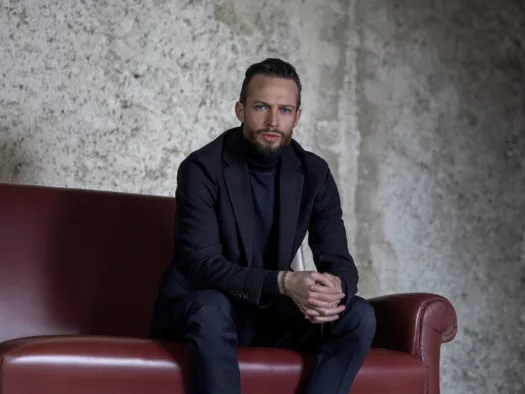
19:45–20:00: Christian Fogarolli will be in conversation with Futurium curator Dr. Gabi Zipf about his work TECHnotOXIC and the invisible connections between humans and the digital world.
Photo: Marta Mancuso
The cables and ducts of the installation thus represent more than technological infrastructure. They point towards an invisible network connecting psychology, economics, technology and power – one in which human experience itself can become data and value.
Between art, medicine and technology
This perspective reflects Fogarolli’s wider artistic practice. Born in Trento in 1983, the artist studied archaeology and art history and has developed his work through research in archives, museums, hospitals and scientific institutions.
His installations, photographs, sculptures and videos explore how systems of knowledge and classification shape our understanding of the human being – particularly concepts of normality, pathology and identity.
For TECHnotOXIC, this research extends into the field of digital dependency. Developed in collaboration with Vita-Salute San Raffaele University in Milan, the project brings together contemporary art, medicine, psychology and philosophy. It draws on research and testimonies concerning phenomena such as smartphone addiction, social isolation, compulsive nighttime use, cyberbullying and other forms of technology-related distress.
The title itself contains a warning. TECHnotOXIC combines “TECH” with “not” and “OXIC”, evoking the absence of oxygen. Fogarolli’s unusual use of upper- and lower-case letters refers to the feeling of being deprived of “air” through excessive technological use.
The future is already here
At Futurium, TECHnotOXIC becomes part of a broader conversation about how technology shapes our lives – from data-driven cities and artificial intelligence to the infrastructures behind the digital world. Fogarolli adds a deeply human dimension to this discussion. His installation asks not only what technology will become, but what we are becoming through our relationship with it.
Together with the accompanying film, the installation creates a kind of future archaeology: a landscape in which the anxieties and dependencies of the digital present appear as artefacts from another time.
Perhaps one day, terms such as FOMO, Phubbing or Brain Rot will be seen as symptoms of a particular historical moment. TECHnotOXIC invites us to look at that moment from the future – while we are still living in it.
Not: Technology – yes or no?
But: What kind of relationship do we want to have with it?