Grafik: Futurium
Launch of the new focus
On/Off Relationship: vernissage
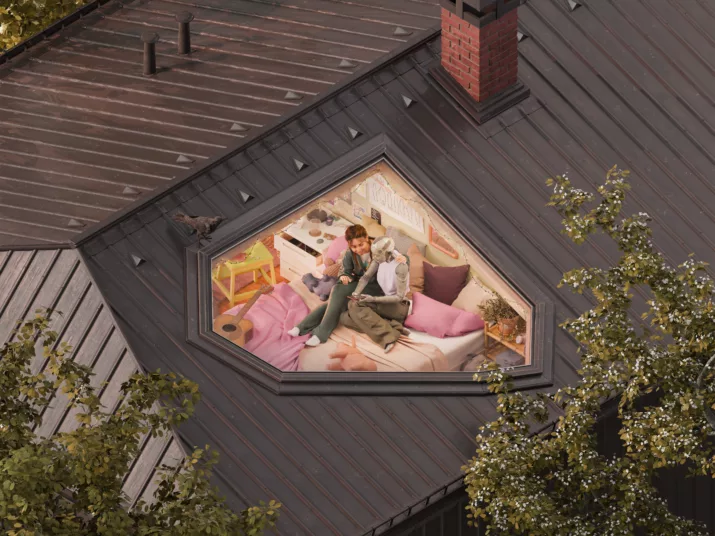
Intelligent machines, empathetic algorithms, brain implants and augmented realities: the boundaries between people and technology seem to be increasingly blurred. How will our understanding of what it means to be human change? Some see the rapid development of technology as the dawn of a golden age, others fear the risks. So where should we be cautious and where should we feel confident? Futurium explores all of this in the "On/Off Relationship" – its new thematic focus on the relationship between humans and technology.
During the opening weekend, in the exhibition and at the series of events starting in autumn, we will be discussing the future of the relationship between humans and machines with you and with contributors from science, politics and civil society.
Grafik: Futurium
Be the first to explore the new thematic focus on the future relationship between humans and machines and come to the vernissage! Discover new exhibits and discuss artificial intelligence and robotics with our experts. Exciting encounters, little surprises and plenty of scope for discussion await you.
18:15-18:35 | Opening Speech
Futurium Director Dr Stefan Brandt opens the new thematic focus “On/Off Relationship”.
Venue: Foyer | Language: German, Englisch & German Sign Language
18:35–18:55 | CONVERGENCE: a negotiation | Performance
Light is reflected onto sensors. A robot dog lifts its head. A robot vacuum changes direction. The performer Silke Grabinger navigates this space – not as the one in control of the technology, but as a participant in an encounter whose rules are yet to be defined. New forms of interaction are emerging between humans and machines that are also captivating the audience.
Using infrared light, Silke Grabinger sets two robots – the dog ‘Spot’ and an autonomous vacuum cleaner – in motion. But after just a few moments, the technology fades into the background. The machines seem to hesitate when it comes to reacting and making decisions. Programmes and mechanics give the impression of them having a mind of their own – and the devices suddenly become partners to interact with. With goals? Preferences? Feelings or even values?
CONVERGENCE opens up a zone in which perception and reality blur, creating a space for interpretation and confusion. The performance invites us to reflect on agency, trust and vitality: what happens when we engage with embodied algorithms as though they were alive? And what does that say about us?
A 15-20-minute version of the CONVERGENCE performance, developed for Futurium. A collaboration between Silke Grabinger, Zirkus des Wissens and Johannes Kepler University Linz
Venue: Foyer
18:45-21:30 | Borrowed Senses | Interactive exhibit
What if technology allowed us to experience the world through unfamiliar senses? For the “Borrowed Senses” exhibit, Futurium teamed up with students to explore how we might use technology to expand the boundaries of our perception in the future. The exhibit features two very different sensory paths.
The first path takes you on an inward journey: “Subtle Sounds” focuses entirely on listening. The moment you put on your headphones, a whole new soundscape unfolds. With the help of 3D audio, you immerse yourself deeply in the nuances of a bird’s song and discover details that the human ear usually misses. The sound installation was developed in collaboration with the Music Design Lab at the Trossingen State University of Music.
The second path opens your eyes to the vastness of space. In “Becoming Many”, you use your body to navigate through space on a VR flight simulator called ICAROS: Even slight shifts in your centre of gravity can alter your course. Smell, movement, heat – little by little, a world beyond human perception begins to reveal itself. The installation from the Future Realities Lab at HTW Berlin reveals what would otherwise remain hidden from our senses.
There's more to the world than what we perceive of it. Both works use technology to translate unfamiliar realms of perception into new, human experiences. Come along and experience the world through borrowed senses!
Venue: Exhibition | on-site registration is required
19:00-21:00| Real or AI? Spotting deepfakes | Hands-on station
Is this image real or was it generated by AI? At our hands-on station, you can test how well you can spot deepfakes yourself. First, put your skills to the test and take a close look: then decide for yourself if it is real or fake.
The ever-increasing prevalence of AI-generated images, videos and audio is changing the way we perceive information online. If everything could be fake, what can we still believe? And how can we tell which sources are trustworthy?
After the quiz, you’ll find out how other people answered, be provided with background information on deepfakes, AI slop and copyright, and discover why media literacy will become even more important in the future.
You can join in at any time.
Venue: Exhibition | Language: German & English
19:00–21:00 | “Doppelgänger” with Rosi Pernthaller and Jim Kramer | Meet and Greet
In “Doppelgänger” exhibition, Rosi Pernthaller and Jim Kramer create digital copies of us and the ways we communicate. Their AI doppelgänger gets to know us: about interests, hobbies and memories all through conversation. It turns us into 3D avatars who encounter other visitors’ avatars in a virtual world. But what do our digital reflections do when we’re not there? And just how much of ourselves is actually in them? Come and meet the two artists at our ‘Ask me anything’ exhibition.
Venue: Exhibition | Language: German & English
19:00–20:00 | Pillow Fight Club: a platform for self-optimisation
Fitness apps count our steps, smartwatches monitor our sleep, and new technologies are constantly emerging that promise to extend our lives or even grant us eternal youth. But where does sensible care end – and where does the pressure to constantly improve oneself begin? What health data do we want to share, and with whom? And should our health insurance status depend on how well our bodies are optimised? And where does all our sensitive health data actually end up? At the “Pillow Fight Club”, you’ll tackle these questions with a hilariously unexpected arena pillow fight.
As soon as you enter, you are assigned to one of four different types of training. After that, it’s onwards to the Pillowdrome – the arena. Armed with pillows, you step into the ring and go head-to-head in a high-energy pillow fight. Amidst competition, heated exchanges and visions of the future, the boundaries between play and taking things seriously start to blur. You experience first-hand what issues such as health data, tracking and body optimisation are like – and, in the process, question their own ideas about what makes up a truly healthy life.
The “Pillow Fight Club” combines performance art, playful competition and socially critical questions about the future to create a unique experience. It invites us to expose the relentless pressure to improve ourselves, all while smiling – and clutching a pillow.
Venue: Forum
19:15–20:00 | Smart, smarter, AI | Talk
Does it help us if we talk about “intelligent” AI? Of course, AI can write texts, have conversations, or programme. But do we use terms such as “understand”, “act” or “think” too lightly? What does it mean for our understanding of ourselves as human beings when we attribute human characteristics to machines? Dr Aljoscha Burchardt explains what today’s AI can actually do and advocates for its development in a way that helps shape a desirable future. But what do we actually consider desirable?
Venue: Exhibition | Language: German & English
19:15–20:00 | I’m simply (un)improvable | Workshop
Are we humans becoming an obsolete model in need of an update? New technologies promise to enhance our physical and mental abilities and help us to overcome illness and halt the ageing process more effectively than ever before. But what exactly is supposed to be improved, and for whom? In this workshop, together with the philosopher Hannah Wallenfels, you will devise a smorgasbord of possible “updates” for humankind. And perhaps you'll also find an answer to the question of who decides what counts as an improvement and what we'd rather give a miss.
Venue: Foyer | Language: German & German Sign Language
19:45-20:00 | TECHnotOXIC with Christian Fogarolli | Artist talk
In his project “TECHnotOXIC”, the Italian artist Christian Fogarolli explores the invisible connections we humans have with the digital world. Through futuristic sculptures and a film, “TECHnotOXIC” explores new forms of dependence and vulnerability – which, for Fogarolli, are symptoms of the human condition today. He asks how attention, time, emotions and behaviour are transformed into data, economic value and instruments of control. His artwork thus creates a landscape of body, technology, and power. In conversation with exhibition curator Dr Gabi Zipf and the audience, Christian Fogarolli offers insights into his artistic practice.
Venue: Futurium Lab | Duration: approx. 15 minutes each | Language: English
20:00-20:15 Uhr | CONVERGENCE: a negotiation | Performance
Light is reflected onto sensors. A robot dog lifts its head. A robot vacuum changes direction. The performer Silke Grabinger navigates this space – not as the one in control of the technology, but as a participant in an encounter whose rules are yet to be defined. New forms of interaction are emerging between humans and machines that are also captivating the audience.
Using infrared light, Silke Grabinger sets two robots – the dog ‘Spot’ and an autonomous vacuum cleaner – in motion. But after just a few moments, the technology fades into the background. The machines seem to hesitate when it comes to reacting and making decisions. Programmes and mechanics give the impression of them having a mind of their own – and the devices suddenly become partners to interact with. With goals? Preferences? Feelings or even values?
CONVERGENCE opens up a zone in which perception and reality blur, creating a space for interpretation and confusion. The performance invites us to reflect on agency, trust and vitality: what happens when we engage with embodied algorithms as though they were alive? And what does that say about us?
A 15-20-minute version of the CONVERGENCE performance, developed for Futurium. A collaboration between Silke Grabinger, Zirkus des Wissens and Johannes Kepler University Linz
Venue: Foyer
20:15–21:15 Uhr | Pillow Fight Club: a platform for self-optimisation
Fitness apps count our steps, smartwatches monitor our sleep, and new technologies are constantly emerging that promise to extend our lives or even grant us eternal youth. But where does sensible care end – and where does the pressure to constantly improve oneself begin? What health data do we want to share, and with whom? And should our health insurance status depend on how well our bodies are optimised? And where does all our sensitive health data actually end up? At the “Pillow Fight Club”, you’ll tackle these questions with a hilariously unexpected arena pillow fight.
As soon as you enter, you are assigned to one of four different types of training. After that, it’s onwards to the Pillowdrome – the arena. Armed with pillows, you step into the ring and go head-to-head in a high-energy pillow fight. Amidst competition, heated exchanges and visions of the future, the boundaries between play and taking things seriously start to blur. You experience first-hand what issues such as health data, tracking and body optimisation are like – and, in the process, question their own ideas about what makes up a truly healthy life.
The “Pillow Fight Club” combines performance art, playful competition and socially critical questions about the future to create a unique experience. It invites us to expose the relentless pressure to improve ourselves, all while smiling – and clutching a pillow.
Venue: Forum
20:30–21:15 | A matter of the mind: how close is too close for comfort? | Talk
We type on keyboards and control devices using voice commands or gestures – but what if we were soon able to control machines directly with our thoughts? What sounds like science fiction is already a reality in medical research today: neurotechnologies such as brain-computer interfaces or smart prostheses can connect the human body to digital systems and restore lost abilities or alleviate neurological symptoms. But what if, in the future, our headphones measure brain waves and healthy people have brain chips implanted?
What opportunities arise when people and technology become increasingly intertwined? Where does the line between therapy and enhancement lie? And how can wearable technologies be designed so that they support people rather than forcing them to conform to the logic of machines?
The neuroscientist and neurotechnologist Prof. Dr Surjo Soekadar provides insights into the current state of research and outlines what developments might be possible in the coming years. Together with you, he discusses how we can shape these technologies in a responsible manner.
Venue: Exhibition | Language: German & English
20:30–21:15 | Love at first prompt | Talk
Artificial intelligence has long since become more than just a text generator and a handy tool: chatbots are becoming confidants; digital companions and robots offer comfort and keep us company, thereby increasingly challenging our notions of closeness, intimacy and partnership. What does it mean when emotional or even romantic relationships develop with AI systems? What distinguishes algorithmically generated intimacy from human connection? And why do people form emotional bonds with digital systems in the first place – from AI chatbots to sex robots?
Psychologist Dr Jessica Szczuka provides insights into the latest research on human-AI interaction. Together with you, we discuss the associated ethical, personal and social issues.
Venue: Foyer | Language: German & German Sign Language
20:45-21:00 Uhr | TECHnotOXIC with Christian Fogarolli | Artist talk
In his project “TECHnotOXIC”, the Italian artist Christian Fogarolli explores the invisible connections we humans have with the digital world. Through futuristic sculptures and a film, “TECHnotOXIC” explores new forms of dependence and vulnerability – which, for Fogarolli, are symptoms of the human condition today. He asks how attention, time, emotions and behaviour are transformed into data, economic value and instruments of control. His artwork thus creates a landscape of body, technology, and power. In conversation with exhibition curator Dr Gabi Zipf and you, Christian Fogarolli offers insights into his artistic practice.
Venue: Futurium Lab | Duration: approx. 15 minutes each | Language: English
21:00-21:15 | CONVERGENCE: a negotiation | Performance
Light is reflected onto sensors. A robot dog lifts its head. A robot vacuum changes direction. The performer Silke Grabinger navigates this space – not as the one in control of the technology, but as a participant in an encounter whose rules are yet to be defined. New forms of interaction are emerging between humans and machines that are also captivating the audience.
Using infrared light, Silke Grabinger sets two robots – the dog ‘Spot’ and an autonomous vacuum cleaner – in motion. But after just a few moments, the technology fades into the background. The machines seem to hesitate when it comes to reacting and making decisions. Programmes and mechanics give the impression of them having a mind of their own – and the devices suddenly become partners to interact with. With goals? Preferences? Feelings or even values?
CONVERGENCE opens up a zone in which perception and reality blur, creating a space for interpretation and confusion. The performance invites us to reflect on agency, trust and vitality: what happens when we engage with embodied algorithms as though they were alive? And what does that say about us?
A 15-20-minute version of the CONVERGENCE performance, developed for Futurium. A collaboration between Silke Grabinger, Zirkus des Wissens and Johannes Kepler University Linz
Venue: Foyer
21:15–22:15 | Pillow Fight Club: a platform for self-optimisation
Fitness apps count our steps, smartwatches monitor our sleep, and new technologies are constantly emerging that promise to extend our lives or even grant us eternal youth. But where does sensible care end – and where does the pressure to constantly improve oneself begin? What health data do we want to share, and with whom? And should our health insurance status depend on how well our bodies are optimised? And where does all our sensitive health data actually end up? At the “Pillow Fight Club”, you’ll tackle these questions with a hilariously unexpected arena pillow fight.
As soon as you enter, you are assigned to one of four different types of training. After that, it’s onwards to the Pillowdrome – the arena. Armed with pillows, you step into the ring and go head-to-head in a high-energy pillow fight. Amidst competition, heated exchanges and visions of the future, the boundaries between play and taking things seriously start to blur. You experience first-hand what issues such as health data, tracking and body optimisation are like – and, in the process, question their own ideas about what makes up a truly healthy life.
The “Pillow Fight Club” combines performance art, playful competition and socially critical questions about the future to create a unique experience. It invites us to expose the relentless pressure to improve ourselves, all while smiling – and clutching a pillow.
Venue: Forum
21:30-22:15 | Communal kitchen | Talk
The best conversations often take place outside of formal settings – instead, everyone coming together at the kitchen table. The countless discussions that have taken place in shared-house kitchens prove this best. That’s why art, AI, philosophy, neurotechnology and psychology come together in our newly established “shared-house kitchen” in the foyer. For 45 minutes, Silke Grabinger, Dr. Aljoscha Burchardt, Prof. Dr. Toni Loh, Prof. Dr. Surjo Soekadar and Dr. Jessica Szczuka form a very special flat-share here and discuss, freely and unscripted, possible futures, hopes, conflicts and what makes for a future worth living with technology – and, of course, the crucial question: who hasn’t sticked to the clean-up schedule again?
Venue: Foyer
22:15–01:00 | DJ set by doktor: Waffel
doktor:WAFFEL gets you in the groove with cheeky energy, quirky beats and feel-good bass.
Venue: Foyer
Information
- Venue: Futurium
- Admission: The event is free of charge.
- Event language: German, English, German Sign Language
- Prior registration is not required.
- Duration: 7 hours
Accessibility
- Translation into German Sign Language
- We keep seats open in case you want to sit close to the stage due to visual impairments.
- People with visual impairments are welcome. We will request guide dog assistance if you need it.
- We are a wheelchair accessible venue. Spaces without seating are available for wheelchair users.
- The event addresses interested people of all ages.
- Participation requirements: no prior knowledge required
- Drinks and food are available for purchase.
The future is for everyone! The Futurium wants to be accessible to everyone.
If there are any other access needs on your part, please feel free to let us know. We will try to meet them: info@futurium.de All information on accessibility can be found here: https://futurium.de/en/accessibility
Photo & Video
- Photos will be taken during the event. If you don’t wish to be pictured, please let us know in advance.
Tickets
- You don’t need a ticket to attend this event.
- Futurium thrives on big ideas – and small contributions. Your donation makes the future possible! You can support Futurium here: https://futurium.de/en/donate