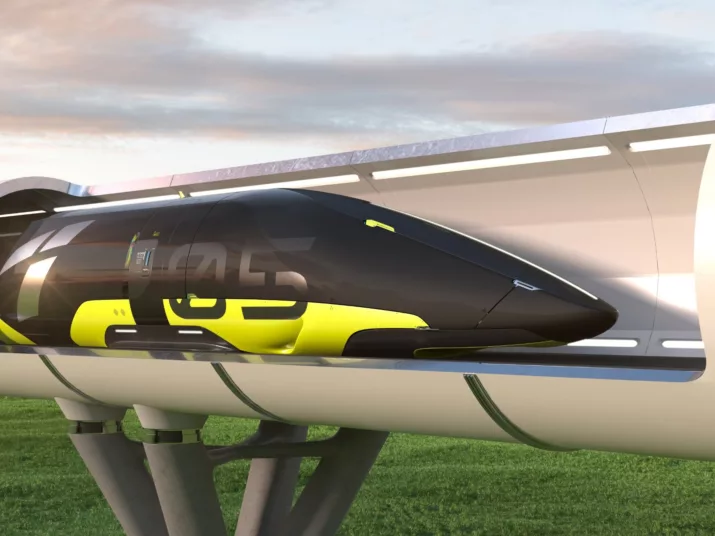
Photo: TUM Hyperloop
The Hyperloop
It’s meant to be fast, cheap and environmentally friendly: it’s called the hyperloop. It’s a transport system for passengers and freight, in which so-called “capsules” or “pods” are shot through an airtight tube that is in partial vacuum. Non-contact levitation and propulsion systems, and low air resistance in the tubes, enable the pods to move ultra-fast.
Photo: TUM Hyperloop
Students at the Technical University of Munich (TUM) have been working on such pod prototypes. And with success: the TUM Hyperloop team from Bavaria currently holds the world speed record with its pod model. One of these TUM models is now with us here at Futurium.
This video from the TV show Galileo (2017) explains in greater detail the working principle of the pods – and takes you through the idea behind them, how they function, and TUM’s participation in the pod competition:
Questions and Answers about the Hyperloop
A capsule that shoots its way through a tube – hasn’t this principle been applied before?
Absolutely. Or at least something quite similar: as early as 1799, the British inventor George Medhurst had the idea of using compressed air and suction to propel postal packages and other items on small carts through iron pipes. Medhurst even thought it might be possible to do the same with humans too. But he himself never got round to turning his idea into reality. Pneumatic tube systems nevertheless became a great success in the following decades. In 2013, entrepreneur Elon Musk finally revealed his plans for the Hyperloop Alpha.
How fast is ultra-fast, actually?
According to Musk’s theory, the hyperloop should reach a cruising speed of up to 1,200 kilometres per hour. With their unmanned hyperloop prototype, the TUM scientists currently hold the world record of 482 kilometres per hour. The company Virgin Hyperloop has already carried out its first manned hyperloop ride. Even though the pod only reached 172 kilometres per hour, the two passengers still enjoyed the ride – as you can see here.
Where could the hyperloop be used?
Because the hyperloop can hit such high speeds, it’s best suited for medium or long distances. The developers at the Technical University of Munich are currently working on plans involving distances of 200 to 1,500 kilometres. Depending on its location, the tube can run either above or below ground.
How many passengers will be able to fit in the hyperloop?
Different companies are developing different pods. In their design, all of them resemble rail carriages, but their sizes vary, as do their possible passenger numbers. Currently, the pod models offer space for between 20 to 60 passengers.
What sort of a travel experience can we expect?
Let’s ask the first passengers! Josh Giegel, co-founder of Virgin Hyperloop, and Sara Luchian, Head of Passenger Experience at Virgin, described their ride on the pod like this: “Exhilarating! I couldn’t think of another word to describe the experience,” Luchian said in an interview with the Observer. The pod accelerated from zero to 107 miles per hour (172 kilometres per hour) in just six seconds. Luchian said she felt a pushback force – not unlike the force experienced during a commercial plane’s takeoff – but it wasn’t unpleasant. The legroom had been generous, but the capsule had not been big enough to enable the two of them to stand up. Unlike in the test of the Virgin Hyperloop project, the commercial versions of the pods are expected to be spacious enough to allow passengers to walk around.
And what will I be paying for a ride?
The projections sound promising: according to Elon Musk’s 2013 presentation of his hyperloop plans, a ticket shouldn’t cost more than 20 dollars. In its 2019 feasibility study, the Mid-Ohio Regional Planning Commission reckoned on a price of 20 US cents per mile. With a distance of nearly 159 miles between Berlin and Hamburg as the crow flies, a one-way ticket would cost 31.80 dollars, which is 27.78 euros.
What are the advantages of the hyperloop?
First up is the travel time. The hyperloop could cover the distance from Berlin to Hamburg in under 20 minutes. Today, the Intercity Express takes about 97 minutes. And then there are the environmental aspects: compared to trains, the magnetic levitation technology is quiet; and by using solar energy and emitting hardly any pollutants, the hyperloop is expected to be a more environmentally friendly alternative. Since the passenger pods move through a tube, the technology isn’t dependent on external influences and is therefore weatherproof. Because of the short periods the hyperloop needs to shuttle between two locations, it can operate at increased frequency, taking much less time than other forms of transport to carry more cargo or passengers.
What are the challenges facing the hyperloop?
The building of the necessary infrastructure is regarded as a major challenge. For instance, the question of where to lay the tubes. Musk came up with the idea of building them along motorways as a way of requiring less new land. Curves, however, may present a problem: the hyperloop needs to decelerate or curve over a large distance – with a curve radius of around eight kilometres at maximum speed – so it can’t keep pace with cars. Safety
is another issue. In June 2020, the TU Delft research group published a report
listing possible danger scenarios: one of them concerns the communication system. The steel of the tube bounces radio signals, and the rapid passage through communication cells could cause breakdowns in communication. In addition, the vacuum around the pod presents a challenge in the event of an emergency evacuation. The scientists conclude that the European hyperloop needs at least to reach the safety level expected of European commercial airlines.
Can the hyperloop be integrated into the existing transport system?
That at least is the goal of the developers. According to TUM Hyperloop, “the key to reducing door-to-door travel time lies in embedding the hyperloop in the current mobility landscape”. Dan Katz of Virgin Hyperloop also views integration into the existing infrastructure as a crucial factor for the success of the new transport system: “We plan to integrate autonomous vehicles to solve the famous ‘last mile’ problem of some trips. And we’re looking at systems to connect ports with inland rail terminals.”
How much is the hyperloop expected to cost?
Hard to say... Elon Musk, for one, estimated in 2013 that a route from Los Angeles to the Bay Area would cost around six billion dollars, that is 11.5 million dollars per mile. The only thing that’s become certain in the meantime is that it will be more expensive: Hyperloop One documents from 2016 show that the company is reckoning on sums of between 84 to 121 million dollars per mile for the route in question. In addition, a 2016 NASA report on the commercial feasibility of the hyperloop projected the cost at 25 to 27 million dollars per mile – for the technology alone, excluding the cost of land acquisition. This figure was calculated for a route from Helsinki to Stockholm running almost entirely underwater. Including pods, it would cost 64 million dollars per mile.
Who is currently carrying out research on hyperloop technology?
In the meantime, various companies and university teams have started to work on this technology. Among them are the US company Virgin Hyperloop One, which has completed its first manned test run, or Hyperloop Transportation Technologies, which has already built several test tracks. Hardt Hyperloop from the Netherlands is planning a hyperloop network for Europe, while the Polish startup Nevomo is working to deploy the Hyperloop on a third track running alongside existing rail lines. A well-known research programme is TUM Hyperloop, whose pods have been dominating the competitions. The non-profit research organisation EuroTube is developing a 3.1-kilometre test tube for pods in Switzerland.