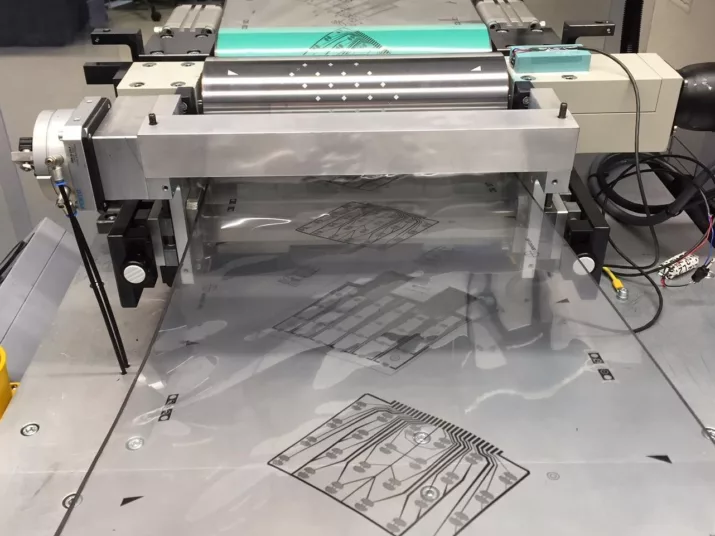
Printed biosensors on a continuous foil: Fraunhofer IBMT has developed a cost-efficient roll-to-roll process. Photo: Fraunhofer IBMT
WHAT CAN GRAPHENE DO?
A material named graphene has been raising great hopes for the future: it’s extremely stable and tear-resistant – and conducts electricity excellently. Theoretically, therefore, graphene is usable in many different areas – even though to date its perfect properties have only been in evidence in the laboratory.
Printed biosensors on a continuous foil: Fraunhofer IBMT has developed a cost-efficient roll-to-roll process. Photo: Fraunhofer IBMT
Here you’ll find five examples of applications, all of which are still at the research stage:
WHAT? SENSORS
How? Sensors can measure, among other things, functions in the human body – which is useful in the medical field.
Why? Graphene is highly flexible and very thin – and this enables it to detect brilliantly even the smallest of movements. [1] This is exactly what’s required to ensure that measurements – both within the body and on its surface – can be carried out without error. [2]
Why not? The effects of graphene on human skin [3] and on the environment [4] have not as yet been researched.
WHAT? SMARTPHONES
How? Many major smartphone manufacturers are currently developing foldable smartphones that have even larger screens.
Why? Graphene is tear-resistant and stable [5], but under certain circumstances it can also be shaped very well – just the right properties for a foldable display. In addition, graphene production consumes only a modest amount of energy. [6]
Why not? Such smartphones would also involve a lot of skin contact with graphene. Its effects on the skin have not as yet been sufficiently researched. [7] Moreover, production would be very expensive.
WHAT? CLEAN DRINKING WATER
How? Membranes –that is, thin separating layers made of graphene – could filter pollutants from raw water to turn it into drinking water. Seawater desalination, for example for agricultural purposes, would also be possible: the graphene membranes could let the water molecules through, while retaining the salt.
Why? The membranes can perform the desalination in one go (unlike in previous methods, the water no longer needs to be filtered several times) and also require only a small amount of energy [8]. This method would therefore be much cheaper and faster than traditional desalination methods.
Why not? A better supply of drinking water could also be achieved through other methods, such as by implementing measures to save water or by improving the infrastructure.
WHAT? SOLAR POWER
How? Graphene could replace silicon, the material currently used in solar energy cells to store energy [9].
Why? Since graphene is flexible and nearly transparent [10], it’s suitable for use in such places as facades, windows and aircraft. It’s also cheaper than silicon.
Why not? The storage capacity of graphene still needs to be improved – only then can it be used efficiently in the solar energy sector. At present, silicon cells are able to generate considerably more energy. [11] In addition, vast amounts of graphene – currently still difficult to produce – would be required.
WHAT? BATTERIES
How? Battery components (anodes and cathodes) can consist partly of graphite – which scientists have now replaced with graphene in experiments.
Why? Graphene ensures that the charge of a battery lasts longer, thereby prolonging the battery’s durability.
Why not? So far, no counter-arguments have been brought forward.
SOURCES AND LITERATURE
[1] https://www.sciencedirect.com/science/article/abs/pii/S0165993617300031?via%3Dihub
[2] https://pubs.acs.org/doi/10.1021/acs.chemrev.8b00573
[3] https://pubs.acs.org/doi/full/10.1021/acsnano.8b04758
[4] https://ucrtoday.ucr.edu/22044
[5] https://www.tum.de/nc/die-tum/aktuelles/pressemitteilungen/details/34160/
[6] https://www.scinexx.de/news/technik/erstes-biegsames-display-aus-graphen/
[7] https://pubs.acs.org/doi/full/10.1021/acsnano.8b04758
[8] https://physicstoday.scitation.org/do/10.1063/PT.6.1.20190703a/full/
[9] https://www.solaranlage.eu/photovoltaik/technik-komponenten/funktionsweise-solarzelle
[10] https://www.alternative-energy-news.info/graphene-solar-cells/