What happens when AI becomes part of military decision-making?
Humans, Machines, Responsibility
Artificial intelligence is transforming warfare – particularly in areas where large volumes of data are analysed, decisions are accelerated, and military operations are automated. Yet the buzzword “AI in warfare” encompasses a wide range of technologies and applications. This makes it all the more important to understand what these technologies can actually do, where their limitations lie, and how human oversight and accountability can be maintained.
Frank Sauer has been examining military technology and weapons autonomy for many years as a political scientist and security expert. Rainer Rehak approaches the subject as a computer scientist and technology researcher, bringing a stronger focus on its social and political dimensions. Together, they offer two distinct disciplinary perspectives on a development that not only expands what is technically possible but also raises fundamental questions about how military decisions are made and who is accountable for them.
Sauer and Rehak answer the same questions – addressing autonomous systems, decision-making power and responsibility, the promises of military AI, and the developments we can expect in the years ahead.
How Does AI Change the Character of War?
Frank Sauer
More speed! That is the central point. Military decision-making processes, particularly when it comes to the controlled use of lethal force, consist of a series of clearly defined functions. If I delegate parts of these processes to machines, I can accelerate them enormously. This is about the “kill chain”: finding, identifying, tracking, selecting, and engaging targets, and subsequently assessing the effects. AI technologies can dramatically speed up these processes—they can fuse sensor data into a common operational picture at machine speed, detect and flag objects, generate targeting information, and guide weapon systems to their targets. The problem is that the comparatively slow human operator increasingly becomes the bottleneck. Speed is therefore highly attractive from a military perspective—but it also carries significant risks.
Rainer Rehak
AI is changing the nature of warfare, above all through the analysis of large and heterogeneous datasets. Tasks that were once handled using conventional statistical methods are becoming increasingly complex and faster. However, newer models such as large language models (LLMs) also introduce a degree of inaccuracy. This is not always simply an error; it can also be an inherent part of how these systems are used. It is therefore essential to distinguish carefully between harm actually caused by AI and harm resulting, for example, from outdated or poor-quality data. AI becomes particularly relevant as data-driven warfare, coordination and automation continue to expand, for instance in the use of drones and drone swarms. Its impact is therefore primarily on how military systems process information and coordinate actions.
How Much Decision-Making Should a Machine Be Allowed to Take Over?
Frank Sauer
At least in some parts of the world, there is a strong proto-norm that decisions over life and death should, as far as possible, not be left to machines. However, this has not been codified in legally binding form. It remains to be seen how stable this norm will prove to be. What is important to understand, however, is that the much-cited “human in the loop” — the human who supposedly must always remain in the decision-making loop, or kill chain — was already something of a chimera in the past and is now definitively outdated. Having a human “in the loop” is of no use if that person does not actually understand what is happening. There are now better paradigms for control. The concept generally used is “Meaningful Human Control.” This means determining, depending on the context, who or what — human or machine — should perform which function in order to preserve predictability, manageability, and accountability. And context is decisive. When defending against an incoming missile at sea, weapon autonomy may be absolutely necessary and life-saving. When identifying a person as a military target in the confusion of infantry combat in an urban environment, the relationship between human and machine needs to be calibrated very differently.
Rainer Rehak
This cannot be determined objectively; drawing the line is an ethical and political decision. One important guiding principle, however, is that the ultimate decision over life and death should not be delegated to machines. This requires careful examination of where the actual decision is made. In target selection systems, for example, a human may formally press the button, while the essential selection has already been made by the system. This is why having a “human in the loop” is not sufficient in itself. Decision-making power and responsibility must go hand in hand: anyone who has significant discretion over an action or authorises the deployment of a system must also take responsibility for the consequences that follow.
Can a Machine Bear Responsibility?
Frank Sauer
No, a machine cannot bear responsibility. It is not a legal subject. Nor do machines “think” or “decide” in the sense that humans do — even if we constantly talk about them that way in everyday language. Human-machine systems must therefore be designed in such a way that human responsibility is preserved. That is precisely what Meaningful Human Control is about: the system’s behavior must be sufficiently predictable and manageable. Humans can and must then assume responsibility for its use — even if the weapon system performs individual functions autonomously.
Rainer Rehak
From a philosophical perspective, a machine cannot bear responsibility because it is not an autonomous agent with its own motivations, interests or intrinsic goals. Responsibility must therefore rest with humans and institutions: operators, developers, military commanders or those who authorise the deployment of a system. The key question is who actually has the ability to exert influence. Legal, military and philosophical responsibility do not necessarily have to be assigned to the same actors. If systems become so complex that decisions and lines of responsibility can no longer be traced, their deployment should fundamentally be called into question. At the very least, it must be clearly defined which level of decision-making bears responsibility.
Does AI Make Wars More Likely — or Less Likely?
Frank Sauer
There is no definitive answer to that yet. On the one hand, unmanned systems expand the range of political and military options available to states. They can do things they might otherwise avoid if doing so directly put their own soldiers at risk. This may lower the threshold for the use of force. On the other hand, what we are seeing in Ukraine is that new technologies also offer enormous opportunities, particularly for the defense. It may therefore become easier to start a war, but that does not mean it becomes easier to win one. At present, these two effects are working against each other.
Rainer Rehak
It is difficult to make a general statement about this. Wars arise from a wide range of political, economic, social and military factors, and AI is always embedded in specific systems and forms of deployment. Even the term “war” itself is contested, depending on the conflict in question. Individual technologies can certainly make military action more likely. Drones, for example, could lower the threshold for certain types of armed intervention. However, making such a claim about AI as a whole would be far too broad. Its many possible applications can have effects in very different directions. Rather than evaluating “AI” as a whole, it is therefore important to examine each specific technology and the context in which it is deployed.
Does AI Actually Improve Military Decision-Making?
Frank Sauer
The potential is certainly there. AI can process vast amounts of data faster than humans, recognize patterns, and potentially make military strikes more precise. This could even help reduce civilian harm. But these systems need to be properly integrated into decision-making processes and used responsibly. Systems and procedures such as “Lavender” and “Where’s Daddy?” in the Gaza war illustrate how not to do this. If a machine generates enormous numbers of potential targets and a human then has only a few seconds to rubber-stamp the result, you have not created better human decision-making. You have hollowed out human control and failed to ensure Meaningful Human Control.
Rainer Rehak
This cannot be answered in general terms. Systems can accelerate decisions or the processes leading up to them, but increased speed may come at the expense of accuracy. Claims that AI automatically makes decisions more precise or safer are therefore unconvincing. It is also essential to define what is actually meant by “better”. The statistical and probabilistic nature of many AI systems can even conflict with traditional military logic, which relies on clear chains of command, control and accountability. If the extent and consequences of inaccuracies cannot be reliably assessed, this may be a reason not to deploy such systems. Many of the promises surrounding military AI are therefore better understood as narratives than as technically substantiated claims.
What Can AI Actually Know?
Frank Sauer
“Knowledge” is a difficult term in this context. I am certainly not someone who doubts the capabilities of today’s leading models. Quite the opposite: I experience genuine “aha” moments with ChatGPT 5.6 Sol virtually every day. At the same time, in the military context, the following still applies — at least for now: a system can process data, consolidate it into an operational picture, recognize patterns, classify objects, and calculate probabilities. It may, for example, identify with a high degree of reliability that an image shows a T-72. But that does not mean it understands the situation and its context. Why is the vehicle there? What is happening around it? What are the intentions of the people standing nearby? Particularly in complex, information-poor social situations, experienced humans possess contextual understanding and judgment that — at least for now — cannot simply be replaced by AI models.
Rainer Rehak
When discussing AI, it is more appropriate to speak of data processing than of “knowledge”. Objectivity and neutrality do not exist in this context: outcomes depend on data selection, processing methods, built-in categories, models and the objectives for which a system is developed or deployed. Terms such as “the right decision” are therefore problematic and must be defined in each specific context. AI can, for example, be useful in developing and simulating scenarios, but their evaluation must remain a human responsibility. The decisive tactical and strategic objectives do not originate from AI itself, but from political and military actors. Anthropomorphising these systems is therefore misleading.
How Realistic Is International Regulation?
Frank Sauer
Unfortunately, there is currently virtually no prospect of it. We have been discussing autonomous weapon systems at the United Nations for more than a decade without producing a binding regulatory framework. At the same time, we are witnessing a geopolitical arms race, while the relevant technologies are diffusing around the world. It would still make sense to define limits on the delegation of critical functions within the kill chain and to establish Meaningful Human Control as an internationally binding principle. But at present, the political will to do so is lacking.
Rainer Rehak
International regulation of military AI is difficult, but not impossible. The development of rules governing other types of weapons also took a long time. What is needed are clearly defined responsibilities and red lines. At the same time, the international order is currently weakened, and states do not always apply international law consistently. Nevertheless, an important legal framework is already in place: AI is a tool and is not deployed outside the scope of existing international law. International humanitarian law can therefore also be applied to military operations involving AI. Additional rules are useful for addressing specific new challenges, but this is not a legal vacuum. Regulation should clarify existing law and ensure that accountability can be enforced in practice.
What Is Underestimated in the Debate About AI and War?
Frank Sauer
We often overestimate how extensively these technologies have actually been implemented within armed forces. Military organizations are large, slow-moving, and often fairly conservative. Sometimes surprisingly idiosyncratic incentive structures come into play as well. The Ukrainians, for example, could employ greater autonomy in their one-way attack drones — loitering munitions — but often prefer to fly them manually all the way to the target because they need the strike video as proof in order to earn points for new equipment. Put provocatively: Gamification is stopping the killer robots! At the same time, we underestimate how much can go wrong when armed forces adopt technologies blindly. This is precisely why Meaningful Human Control is so important. The question is not only what is technically possible, but how the entire human-machine system can function under real operational conditions in compliance with international humanitarian law.
Rainer Rehak
This highlights how differently both “AI” and “war” can be understood. It is also important to recognise that inaccuracy is not a rare exception but an inherent characteristic of many AI systems. The widespread narrative of automatic precision can serve to legitimise problematic applications. At the same time, current applications are establishing precedents that other states may follow. Clear frameworks are therefore essential when decisions involving life and death are at stake. Nevertheless, the debate must not become overly focused on technology. Power, interests, alliances and political alternatives are equally important. Technical analysis is necessary, but it must not overshadow the political debate about causes, objectives and responsibility.
If We Look Ten Years into the Future: What Will AI Have Fundamentally Changed in the Military Domain — and What Should We Be Talking About Today Before These Developments Become Irreversible?
Frank Sauer
One area I have been thinking about a great deal recently is humanoid robotics — embodied AI — for military applications. After all, there are military tasks for which the human form factor is advantageous because our entire environment has been built for humans: doors, stairs, vehicles, tools. Where humans need not merely to be augmented but actually replaced, a humanoid robot may prove useful. For me personally, there is a certain irony in this. I have been working on weapon autonomy for around twenty years, and in countless interviews I have repeatedly explained: No, this is definitely not about the Terminator. Well. It is now entirely possible that, ten years from now, my answer will be different. And that is precisely why we should be thinking today about which tasks we want to entrust to such systems — before the technology is operational.
Rainer Rehak
Over the next ten years, AI will likely have changed the way warfare is conducted, but perhaps less fundamentally than other technologies, such as drones. What is more likely to change significantly is the political economy of the military: more money will flow into AI development, computing power, data infrastructure and the companies providing these technologies. As large AI models are extremely expensive to develop and operate, and many providers are still searching for sustainable business models, military contracts are becoming increasingly attractive. On the battlefield, other developments may have a more significant impact, including simulations, situational awareness, digital representations of battlefields and hybrid warfare. The more profound transformation brought about by AI may therefore initially take place in investment, procurement and military infrastructure.
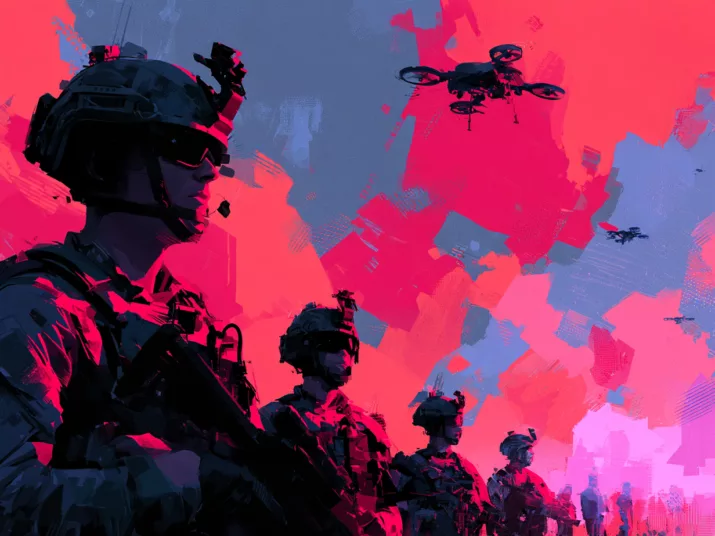
The image used for this blog post was created using the AI-powered image generation technology Midjourney. It is intended for illustrative purposes and may contain stylized or abstract representations. All rights to the generated images are held by Futurium or the respective copyright holders, where applicable. The following prompt was used: “An abstract image that shows how warfare is influenced by artificial intelligence, show soldiers and drones in bright colours.”