© berlin-event-foto.de
A science action day
In Touch with the Future
What might the world of tomorrow look like? There are countless ideas for it, some of which you can find here at Futurium. Look into the laboratories of the future with us!
© berlin-event-foto.de
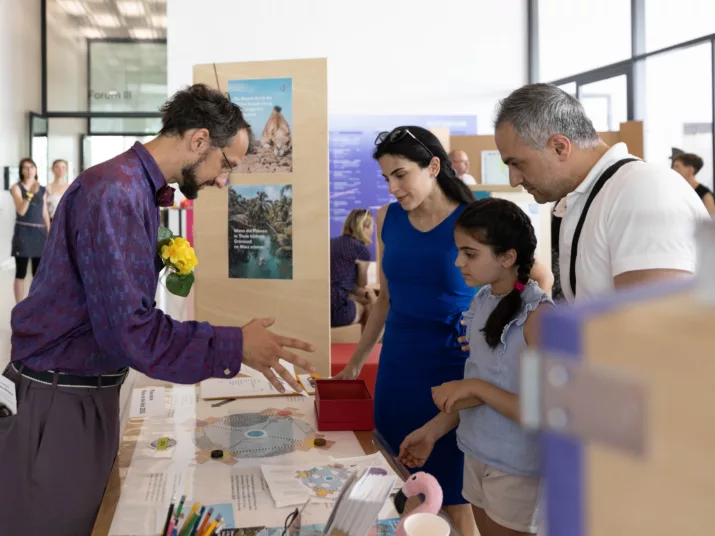
You’ll experience an exciting day full of discoveries in the fascinating world of tomorrow: experiment, ask questions, tinker with inventions. With multi-touch tables, VR glasses, quizzes and much more, curious kids and knowledge-hungry adults alike will find much to explore – from transmitters for tracking vultures to the secrets of the human language and the biological diversity of cabbage. Futurium’s partners and contributors will be offering exclusive insights into their visions and demonstrate how they’re actively shaping the future. Find out what’s already being researched and worked on today and what could soon be reality.
In friendly cooperation with our partners:
Federal Ministry of Research, Technology and Space (BMFTR), German Academic Exchange Service (DAAD), Fraunhofer-Gesellschaft, Helmholtz Association of German Research Centres (Hermann von Helmholtz-Gemeinschaft Deutscher Forschungszentren e.V.), Joachim Herz Foundation, Leibniz Association, German Research Foundation (DFG), German National Academy of Sciences Leopoldina (Deutsche Akademie der Naturforscher Leopoldina e.V. – Nationale Akademie der Wissenschaften)
Program
12:00-16:00: FAMILY OPEN LAB - IDEAS FOR THE FUTURE OF DEMOCRACY
What will the democracy of the future look like? With us by your side in the Futurium Lab, you’ll have the chance to engage with the challenges and opportunities that lie ahead.
In this format, you can develop your own ideas and visions for desirable futures. What do you require from the democracy of tomorrow? Use the laser cutter to create stencils - spray-paint stencils - to make your demands visible in the real world. You’ll find yourself in a fictitious scenario in which the focus is on democracy and on AI applications using facial recognition. To protect your own identity from surveillance and facial recognition, you’ll need to design anti-facial-recognition masks and camouflage them using different patterns. Our mentors will help you bring your ideas to life and show you how the laser cutter works. Helpful learning materials are also on hand to support you.
This drop-in format is open and differs from traditional workshops. Our plan is for you to spend around 20 minutes in the Lab to get your first taste of the technology and the topic of the future. If it’s particularly busy, it might be the case that not all participants have time to try out all the interactive points. So be flexible and take the opportunity to get involved with the exciting topics on offer!
12:00: BETWEEN ARRIVING AND GETTING GOING – AN INTRODUCTORY TALK
What happens when we leave our familiar surroundings behind? This introductory talk will take you on a journey through personal experiences gathered from various stays abroad - and show you how they can have a lasting impact on your life and work. The ambassadors from the German Academic Exchange Service (DAAD) recount why experiences abroad are so much more than just an academic adventure: they change our perspectives, expand our fields of action and promote intercultural understanding. An inspiring contribution for all those who are thinking about going abroad themselves – or supporting their children in doing so – and who are asking themselves the question: What’s actually to be gained from it?
1:00: INTERACTIVE CHEMISTRY SHOW
Are ultra-processed foods harmful? What innovative products is food research working on? And do you want to know which ingredients in food are actually good for our health? Answers to your questions can be found from Sascha Rohn, Professor of Food Chemistry at TU Berlin. He conducts research on plant-based foods and, at the invitation of the German Research Foundation (DFG), will be presenting you with the latest research topics.
2:00: "TOMORROW I'LL BE EATING... DIFFERENTLY?": THE AGRICULTURE QUIZ
What will end up on our plates tomorrow – and where does it actually come from? In the agriculture quiz "Tomorrow I'll be eating... differently?", the Federal Ministry of Research, Technology and Space (BMFTR) will be inviting families to an exciting journey of discovery into the future of our food. Whether it's salad from the indoor farm, veggie burgers or AI-controlled cultivation methods - here, young and old will be answering questions about the agricultural economy of tomorrow and learning from scientists how research and modern technology help secure food and protect the climate and the environment too.
3:00: “I MAKE THE WORLD THE WAY I LIKE IT!” AN INTRODUCTORY TALK
You probably know this sentence from Pippi Longstocking. But, hand on heart, doesn't it often feel these days like the world no longer lets itself be shaped as simply as we’d like? News, social media and discussions constantly revolve around the climate crisis, nature conservation and worries about having to give things up. But is that really the whole truth? Perhaps now is the right time for a bold rethink. Prof. Dr. Andrea Büttner from the Fraunhofer Institute for Process Engineering and Packaging (IVV) will show you how we can make our food supply and everyday items more resilient.
4:00: HEALTH, NUTRITION, CLIMATE CHANGE, LANGUAGE - THAT'S WHY BIODIVERSITY IS SO IMPORTANT! AN INTERACTIVE TALK
Findings and recommendations from the ten must-knows from biodiversity research in 2024: how are climate and biodiversity related? Why are even species that we hardly notice indispensable? What role does language play in our relationship with nature? And what does a forest that can withstand climate change and defy extreme weather look like? The "ten must-knows from biodiversity research" will give you exciting answers – and show you what you can do to protect nature and biodiversity. In her role as a member of the Leibniz Association, geoscientist PD Dr. Kirsten Thonicke from the Potsdam Institute for Climate Impact Research explains what biological diversity means, why we are losing it so rapidly and what solutions exist. Your questions and thoughts are expressly welcome!
In the foyer
PEOPLE, ANIMALS, CABBAGE SENSATIONS!
Planting the future: what’s in cabbage
The Leibniz Institute of Vegetable and Ornamental Crops (IGZ) – supported by the federal government, the state of Brandenburg and the Leibniz Association – invites you to immerse yourself in the "SharpGreens"
project, in which you’ll get to know about the colourful varieties of the cabbage plant. Discover how diverse cabbage is, what it can do for your health - and experience its biodiversity all here on site. You can get active yourself and explore the cabbage with all your senses.
Animals as a source of knowledge for our future
At the stall of the Leibniz Institute for Zoo and Wildlife Research (IZW) you can discover the amazing knowledge animals have about nature and environmental change. Experience how we humans use this knowledge with state-of-the-art technology: from tiny transmitters for animals to intelligent AI analysis tools and space technologies. Take a look behind the scenes of research and find out how animals help us better understand and protect our environment.
Discover languages, experience research
The Leibniz-Centre General Linguistics (ZAS) invites you to immerse yourself in the world of languages in a playful way. From the "Berlin Interdisciplinary Network for Multilingualism (BIVEM)" you will learn why multilingualism is so exciting. You will also get to know two research projects: "SPEAK", in which playful language tests are developed, and "LeibnizDream", where researchers find out what the typical "mistakes" made by children reveal about our thinking. In hands-on experiments, children from the age of two and a half and adults can try out for themselves how language research works.
New agriculture
What will the agriculture of tomorrow look like? The "Agricultural Systems of the Future" funding programme of the Federal Ministry of Research, Technology and Space (BMFTR) shows how exciting ideas are already being researched today: from robots that pull weeds to cows with digital collars to unusual foods such as algae, jellyfish or insects – all for you to marvel at and try out!
At the large multi-touch table, you can playfully discover how we’ll be producing our food in the future – in German or English, for children and adults. Immerse yourself in a vivid world of the future, try things out for yourself and talk to us about the agriculture of tomorrow.
COME TO THE GLASS LABORATORY!
The Helmholtz Association of German Research Centres, together with the Glass Laboratory, invites you to gain fascinating insights into current medical research. At an interactive stall, visitors can become active themselves, try things out and discover new things: what role does the intestinal microbiome play in the heart? What does hand strength reveal about the ageing process? With VR glasses, you can explore the heart right up close – and in the process learn more about heart health, how an ECG works and what happens in the body during a heart attack. You can take part in the quiz and test your knowledge.
The Life Science Learning Lab (Gläsernes Labor - Glass Laboratory) is the joint school laboratory of the institutions of the Campus Berlin-Buch and is part of a network of 33 school laboratories run by Germany’s largest scientific organisation, the Helmholtz Association of German Research Centres
NEXT STOP: FUTURIUM!
What is important to you for the future? What ideas do you have for a good life? You are invited to think about these questions by the Utopiamobile of Die Junge Akademie (“the Young Academy” for outstanding young academics) at the Berlin-Brandenburg Academy of Sciences and Humanities and the German National Academy of Sciences Leopoldina. Here you can share your ideas, come up with crazy stories of the future and talk about them with others. It's a bit like a time machine, a cosy break from everyday life and a huge, blank sheet of paper on which you can paint or write anything that comes into your head.
In politics and science, problems are often put at the forefront. The Utopiamobile sets a different focus: developing positive visions of the future together that encourage and initiate change. Drop by and bring along your ideas for the future – because good utopias can only be created together!
MOORS, CLIMATE & PALUDICULTURE
The Greifswald Mire Centre and the Joachim Herz Foundation invite you to discover the fascinating world of moors. Learn about the important role peatlands play in climate and nature conservation and how peatland rewetting and paludiculture – the productive cultivation of wet and rewetted peatlands - open up new avenues for agriculture and sustainable raw materials.
Here you can be a researcher yourself: feel peat mosses and products made from paludi-materials, discover your nearest moor on the Germany moor map, paint and play with interactive elements or browse through exciting materials such as the moor atlas and postcards. Drop by and let all your senses experience the richness of moors!
Information
- Venue: Forum, Lab, Forecourt
- The event is free of charge.
- Event language: German
- Participation requirements: no prior knowledge required
Accessibility
- We are a wheelchair accessible venue.
- Spaces without seating are available for wheelchair users.
- We keep seats open in case you want to sit close to the stage due to visual impairments.
- People with visual impairments are welcome. We will request guide dog assistance if you need it.
- The event addresses interested people of age 14+.
- Drinks and food are available for purchase.
The future is for everyone! The Futurium wants to be accessible to everyone.
If there are any other access needs on your part, please feel free to let us know. We will try to meet them: info@futurium.de
All information on accessibility can be found here.
Photo & Video
Photos will be taken during the event. If you don’t wish to be pictured, please let us know in advance.
Tickets
Tickets are not required for this event.